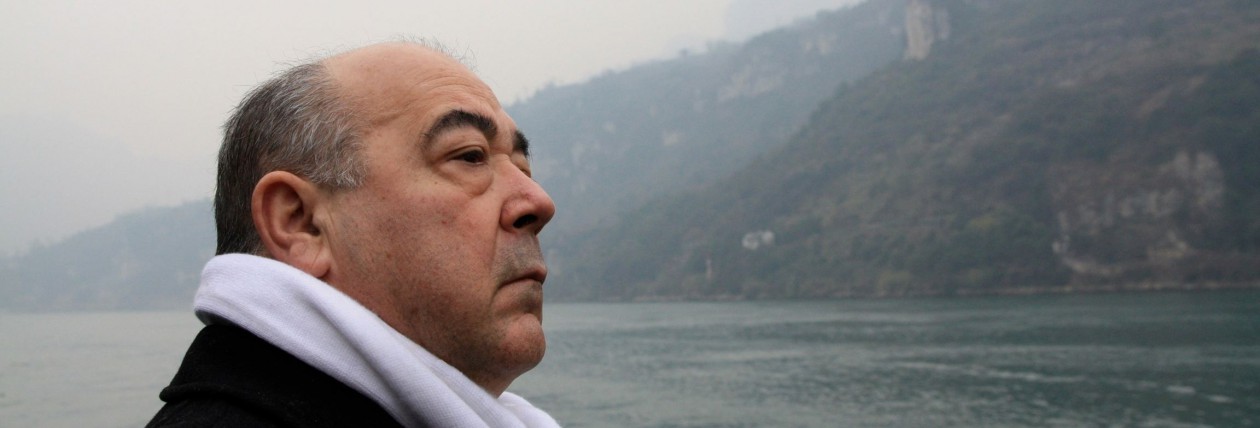
Pierre Padilla: Vision and Action

SEFI Fellowship 2011 Laudation. Lisbon, 30 September 2011,
Dear members and friends. It is my pleasure -and challenge- to introduce to you Professor Pierre Padilla, a former SEFI Vice-president, as SEFI fellow. My challenge is to summarize the achievements of a man driven by a bold vision and by restless action, among the most intensively, consistently and continuingly committed contributor to our shared cause of engineering education.
Those of us, who recently visited the brand new building of the school he leads, the vibrant Ecole Nationale d’Ingénieurs de Metz, observed an unusually international buzz among students, from France obviously, but also Romania, Spain, Colombia, Argentina, Brazil, Morocco, Togo, China,… 30 foreign nationalities compose one third of the 1000 students of this human-sized school. This international atmosphere translates in the curriculum itself. I am not aware of another institution where, not one, but two international internships are mandatory to earn an engineering degree.
Allow me now to call him Pierre.
Pierre boldly illustrated the importance of developing “global engineers” when he founded in 2006 the Cartagena Network of Engineering, an extraordinary forum for universities, vocational education institutions, professional associations and corporate, pushing the frontiers of engineering education in 20 different countries.
His international openness may originate in his past role as associate program director for Latin America at the United Nations Industrial Development Organization, or in his birthplace, the Spanish province of Almeria, a place profoundly marked by Arabic culture but also the location where Italian film makers shot wonderful US style Western movies.
The recognition of engineering’s global nature illustrates Pierre’s vision: an engineer operates in an increasingly complex and broad system. Educating an engineer requires a global, multi-disciplinary, industry-connected learning environment.
While he started –and never stopped- his career in mechanical and industrial engineering (in a recent paper he addressed “Experimental simulation of the efficiency of high speed grinding wheel cleaning”), he now approaches education as a system engineer. This systemic vision inspires his research on the application of system engineering methods to educational processes. In 2008, he published “A control system for Learning applied to Higher Education”.
When you start looking at education as a system you end up in territories which are far away from resolving second order differential equations. You explore the difficult path of multi-disciplinary education. This obviously concerns student projects and you would be amazed to see a group of Pierre’s students, dispersed in different countries, remotely commenting the computer model of an autonomous, multi-source electricity generator for Senegal. Students’ projects however, are the easy facet of multi-disciplinary education. Too easy for Pierre! So he tackled the bumpy side and combined disciplines within the curriculum. He directed significant funding to continuing educators’ education, recognizing that this is the critical evolution enabler.
Industry collaboration is another expression of his holistic approach. Without detailing his impressive consulting work to increase efficiency of several European industry leaders, I would rather praise his systematic implementation of industry projects involving students, in addition to their internships, with their professors, in industry-funded projects. These projects are not only great educational instruments to enforce entrepreneurship, accountability and professionalism for students (and educators), they are also a strong fundraising mechanism. Attracting funds, yet never compromising academic freedom is one of Pierre’s talents, a competence which any education leader should nurture in today’s economy.
Pierre’s student-centric, systemic vision however, culminated last year when French media reported that he introduced “lifelong employability”, an innovative insurance mechanism which guarantees unemployed alumni to receive a salary and complementary education from their alma mater, should this unfortunate, but rare case happen.
Dear members and friends, Professor Padilla’s CV contains many other brilliant achievements and prestigious titles. Today, there will be one more. Our association can be proud to welcome as a SEFI Fellow a man of vision and action.
 Pierre Padilla